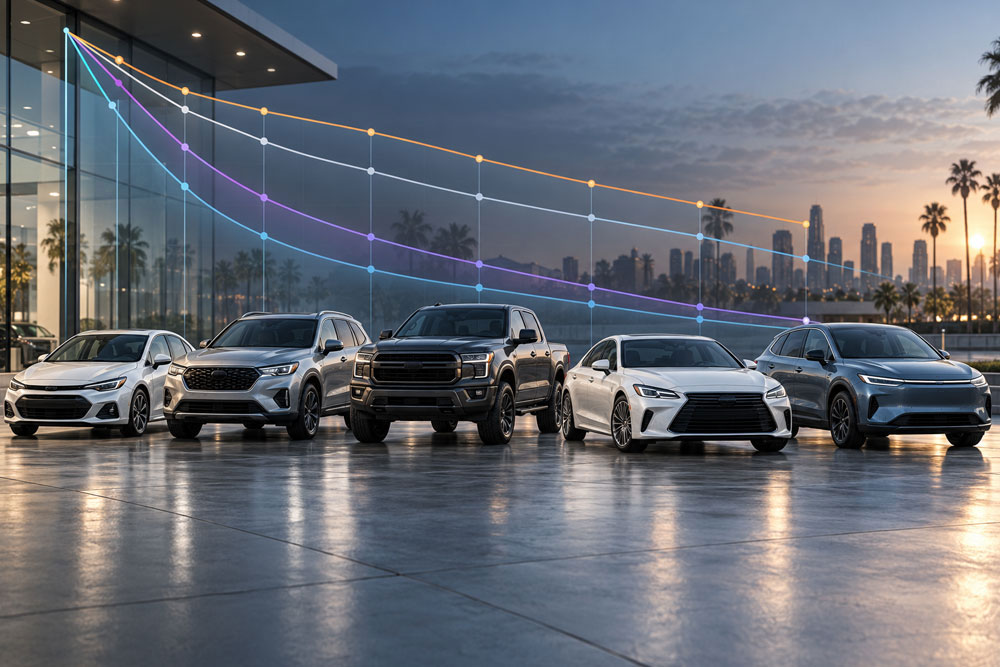

You bought your car for one price, drove it for a few years, kept it in good condition, and then checked its current value. The number can be surprising. Sometimes it can feel as though thousands of dollars disappeared even though the vehicle still looks, drives, and performs almost exactly as it did when it was newer.
So, why did your car value drop so fast?
The answer is usually depreciation, but depreciation is more complicated than simply subtracting a fixed percentage every year. Cars depreciate along different curves depending on their vehicle class, brand, powertrain, mileage, condition, options, original price, local demand, incentives on new models, supply levels, and even changes in technology.
A pickup truck may retain value very differently from a luxury sedan. A hybrid SUV can follow a different curve from a comparable gasoline SUV. An electric vehicle may experience a sharp adjustment if newer versions receive major improvements or price reductions. Even two vehicles purchased for nearly the same amount can have dramatically different resale values several years later.
Understanding how vehicle depreciation works can help Los Angeles and Burbank drivers make better decisions about when to sell a car, whether to keep driving it, and how to evaluate the equity remaining in a financed or leased vehicle.
What Is Car Depreciation?
Car depreciation is the reduction in a vehicle's market value as it ages and accumulates mileage.
When you purchase a new vehicle, you are paying for a brand-new product with no previous owner, minimal mileage, full remaining warranty coverage, current technology, and the appeal of choosing a new model. Once that same vehicle becomes used, buyers evaluate it differently.
The vehicle may still be excellent, but the used market now compares it against other used vehicles rather than only against its original manufacturer's suggested retail price.
Depreciation is not necessarily an indication that something is wrong with your car. It is a market adjustment based on what buyers are willing to pay for that vehicle today.
Several factors affect that number:
- Vehicle age
- Mileage
- Make and model
- Vehicle class
- Condition
- Accident and damage history
- Maintenance history
- Reliability reputation
- Fuel economy
- Powertrain type
- Remaining warranty coverage
- New-car pricing and incentives
- Used-car supply and demand
- Regional demand
- Trim level, equipment, and options
This is why a generic depreciation calculator can provide only an estimate. The real market value of a specific vehicle depends on how all of these factors interact.
Why Do Cars Lose Value Fastest When They Are New?
The depreciation curve is usually steepest during the early years because a new vehicle quickly transitions from new-car pricing into the used-car market.
The largest psychological and economic distinction in automotive pricing is often the difference between "new" and "used." A vehicle with only a small amount of mileage is still a used vehicle after it has been sold and titled.
New-car buyers may also receive manufacturer incentives, promotional financing, lease support, warranties, or dealer programs that are not directly reflected in the manufacturer's sticker price. Used-car buyers compare their alternatives against those offers.
As a result, a one-year-old car is not simply valued at the original price minus one year of wear. The market asks a different question: how much would someone pay for this used vehicle compared with buying a new one?
After the initial steep portion of the depreciation curve, value loss often becomes more gradual. However, additional drops can occur when a vehicle reaches mileage thresholds, leaves warranty coverage, undergoes a major redesign, or faces changing demand.
How Fast Do Cars Typically Depreciate?
There is no single depreciation rate that accurately describes every car.
General automotive estimates often show significant depreciation during the first several years of ownership, but class-level differences can be substantial. Current market research continues to show that trucks and hybrids, for example, can retain value considerably better on average than some electric vehicles and luxury vehicles.
This is why two owners can have completely different experiences.
One owner might purchase a popular pickup, drive it for several years, and discover that market demand has preserved a surprisingly large portion of its original value. Another person might purchase an expensive luxury sedan and discover that the dollar amount lost during the same period is much larger.
The depreciation curve matters more than a generic depreciation percentage.
How Do Depreciation Curves Differ by Vehicle Class?
Vehicle class can significantly influence resale value because each class attracts different buyers and responds differently to supply, demand, fuel prices, technology changes, and ownership costs.
Understanding the major categories can explain why your car may have lost value faster or slower than expected.
Pickup Trucks
Pickup trucks have historically been among the stronger vehicle categories for value retention, although individual results vary widely by model.
Part of the reason is utility. Buyers use trucks for construction, contracting, towing, recreation, transportation, and everyday driving. A well-equipped truck can remain useful long after it is no longer new.
Demand is also spread across personal and commercial buyers. In Southern California, certain trucks can attract buyers ranging from contractors and small businesses to families and outdoor enthusiasts.
Configuration matters substantially. Engine choice, drivetrain, towing equipment, cab size, bed length, trim, mileage, and condition can all influence resale value.
A truck with a desirable configuration and excellent condition can therefore follow a much flatter depreciation curve than a vehicle from a class with weaker used-market demand.
Hybrid Vehicles
Hybrids have become an increasingly important part of the used-car market because they combine fuel efficiency with familiar gasoline-powered operation.
For many buyers, a hybrid provides improved fuel economy without requiring them to rely entirely on charging infrastructure. That broad appeal can support used-car demand.
Hybrid resale value can be particularly strong when the model has a reputation for reliability, fuel economy, and practical everyday use.
Battery condition, mileage, maintenance history, brand reputation, and warranty coverage still matter. However, popular hybrid cars and SUVs can depreciate differently from comparable gasoline-only models.
SUVs and Crossovers
SUV depreciation varies considerably because the category is extremely broad.
A compact crossover purchased primarily for commuting has a different buyer base from a full-size three-row SUV designed for families or towing. Luxury SUVs can also behave differently from mainstream SUVs.
Used SUVs generally benefit from widespread consumer demand because buyers value cargo capacity, seating position, flexibility, and available all-wheel drive.
However, popularity alone does not guarantee strong resale value. A model with poor reliability perceptions, expensive maintenance, weak fuel economy, or excessive new-vehicle inventory can lose value more quickly.
For sellers, the exact make, model, drivetrain, trim, mileage, and condition matter more than simply saying, "I own an SUV."
Sedans
Sedans can offer excellent transportation value, but their depreciation patterns depend heavily on brand and segment.
Compact and midsize sedans from manufacturers with strong reliability reputations may maintain steady used demand. Large sedans and less popular models can face a smaller pool of buyers as consumer preferences have increasingly shifted toward crossovers and SUVs.
A sedan that depreciates significantly is not necessarily a poor vehicle. It may simply be operating in a market where there are more used examples available than consumers looking to buy them.
That distinction is important: vehicle quality and market value are related, but they are not the same thing.
Luxury Cars
Luxury vehicles can experience some of the largest depreciation losses in dollar terms.
Imagine two vehicles that each lose a similar percentage of their original value. If one originally cost considerably more, its owner experiences a much larger dollar loss.
Luxury cars also face several forces that can accelerate depreciation.
Used buyers may be concerned about repair and maintenance costs after warranty coverage expires. New luxury models frequently introduce updated technology, styling, driver-assistance systems, larger screens, improved performance, or redesigned interiors. Those changes can make an older model appear dated faster than a simpler mainstream vehicle.
New-car lease programs can also influence the supply of relatively young luxury vehicles entering the used market.
As a result, a three- or four-year-old luxury car may still look impressive while selling for substantially less than its original price.
Electric Vehicles
Electric vehicle depreciation has attracted considerable attention because the EV market changes quickly.
Current industry research shows that EVs as a group have experienced heavier five-year depreciation than several major gasoline, hybrid, and truck categories, although results vary dramatically by manufacturer and model.
There are several possible reasons.
Battery range and charging speed continue to improve. Newer models can enter the market with more range or updated technology, changing how buyers value earlier vehicles. Manufacturer price adjustments and incentives on new EVs can also affect used prices almost immediately.
Suppose a new version of a vehicle suddenly becomes thousands of dollars less expensive. Used buyers will naturally reconsider what an older example should be worth.
Battery health, warranty coverage, charging standards, software features, and access to charging infrastructure can also influence the resale market.
This does not mean every EV depreciates at the same rate. Some models have much stronger demand than others. The important point is that EV valuations can move quickly when technology and new-car pricing change.
Sports Cars and Performance Vehicles
Performance vehicles can follow some of the least predictable depreciation curves.
High-volume performance cars may depreciate like normal vehicles during their early years. Scarce models, limited-production configurations, vehicles with manual transmissions, or cars with unusually strong enthusiast demand can behave differently.
Condition becomes especially important.
A performance vehicle that is original, well maintained, accident-free, and carefully driven may appeal to enthusiasts more than an example with extensive modifications or signs of aggressive use.
Some rare enthusiast vehicles can eventually stabilize or increase in value, but that should not be assumed when estimating an ordinary used car's resale price.
Why Did My Car Suddenly Lose More Value This Year?
Sometimes your vehicle did not physically change very much, but the market around it did.
Used-car values are influenced by conditions outside the owner's control.
For example, your vehicle's value can change when:
- The manufacturer significantly discounts the new version.
- A redesigned model reaches dealerships.
- More off-lease examples enter the used market.
- Fuel prices change buyer preferences.
- Interest rates affect affordability.
- A manufacturer changes incentives.
- Consumer demand shifts toward another vehicle category.
- The market gains more comparable used inventory.
These changes explain why a valuation from several months ago may no longer match today's market.
A vehicle is worth what the current market supports, not what it was worth at the previous appraisal.
Does Mileage Make My Car Depreciate Faster?
Yes, mileage is one of the major variables affecting used-car value, but mileage should be considered together with age and condition.
A three-year-old car with unusually high mileage is generally valued differently from another three-year-old example with substantially lower mileage.
However, low mileage does not automatically guarantee maximum value.
A low-mileage vehicle with body damage, neglected maintenance, worn tires, warning lights, interior damage, or an accident history may be worth less than a higher-mileage vehicle that has been carefully maintained.
This is one reason a physical vehicle inspection can reveal information that an automated valuation tool cannot fully capture.
Why Does Condition Matter So Much to Resale Value?
Two vehicles with the same year, make, model, trim, and mileage can still have different market values because their real-world conditions may be very different.
Online valuation systems typically begin with standardized assumptions and data. They may ask whether the condition is excellent, good, fair, or poor, but owners and buyers may interpret those labels differently.
An in-person inspection can evaluate details such as:
- Paint and body condition
- Previous repairs
- Interior wear
- Tire condition
- Mechanical condition
- Warning lights
- Glass damage
- Wheel damage
- Unusual noises or vibrations
- Equipment and options
- Overall care
A well-maintained vehicle may deserve a stronger appraisal than an algorithm initially suggests. Conversely, undisclosed damage can reduce what buyers are realistically willing to pay.
Does Where I Live Affect My Car's Value?
Yes. Used-car values can vary geographically because buyer preferences and local market conditions are different from one region to another.
A vehicle that is highly desirable in Los Angeles may receive different demand somewhere else. Climate, fuel costs, commuting habits, density, lifestyle, and local inventory can all influence resale value.
Southern California is an enormous automotive market. Buyers in Burbank, Los Angeles, Orange County, and San Diego may have access to large inventories, which means sellers are competing against many comparable vehicles.
At the same time, Southern California's size creates demand for an enormous range of cars, trucks, hybrids, EVs, luxury vehicles, and specialty models.
A local appraisal therefore provides context that a broad national estimate may not capture perfectly.
Why Is My Trade-In Value Different From the Price of Similar Cars Online?
The retail asking price of a used vehicle and the amount someone can pay you for your vehicle are not the same number.
A used car advertised for sale has typically gone through acquisition, inspection, transportation when necessary, detailing, reconditioning, repairs, inventory preparation, marketing, and other costs before reaching the retail market.
An asking price is also not necessarily the final transaction price.
That is why looking at similar cars listed online and assuming your car is worth exactly the same amount can produce unrealistic expectations.
A proper appraisal considers what the vehicle can realistically sell for, what condition it is actually in, current market demand, necessary reconditioning, and the costs associated with preparing it for resale.
Can a Car Be Depreciating While I Still Have Positive Equity?
Yes. Depreciation and equity are related but different concepts.
Depreciation describes how the vehicle's market value changes. Equity describes the difference between the vehicle's current value and the amount you still owe.
For example, your vehicle can be worth less than it was last year but still be worth more than your remaining loan payoff.
If the vehicle is worth more than the payoff, you may have positive equity.
If the payoff is greater than the current vehicle value, you have negative equity.
This distinction becomes especially important when deciding whether to sell, trade, or replace a vehicle.
Can a Leased Car Have Equity?
Yes, a leased vehicle can sometimes have equity when its current market value exceeds the amount required to acquire it under the applicable lease-buyout structure.
This became especially noticeable during periods when used-car values rose sharply, but lease equity can exist under more normal market conditions as well.
The challenge is that leased vehicles involve additional variables. The registered driver is not necessarily the legal owner of the vehicle. The leasing company controls the title, and different manufacturers and financial institutions can impose different requirements on third-party purchases.
Some brands restrict which dealers can buy their leased vehicles directly. That can turn a seemingly straightforward sale into a complicated payoff and title transaction.
Anyone evaluating a leased vehicle should therefore consider more than the estimated retail value. The lease payoff, market value, permitted buyer, taxes or applicable transaction requirements, and equity position all need to be evaluated together.
When Is the Best Time to Sell a Depreciating Car?
There is no universal perfect time to sell, but understanding your vehicle's depreciation curve can help you make the decision more strategically.
Selling sooner can make sense when the vehicle still has strong demand and substantial equity, especially if you were already planning to replace it.
Waiting may make sense when the steepest portion of depreciation has already occurred and the vehicle continues to meet your needs economically.
Consider the following questions:
- What is the vehicle worth today?
- How much do I currently owe?
- Do I have positive equity?
- Is the vehicle approaching a major mileage threshold?
- Is the factory warranty nearing expiration?
- Is a redesigned version about to enter the market?
- Are new-car incentives reducing the value of used examples?
- Does the vehicle need expensive maintenance soon?
- Is demand for my specific vehicle currently strong?
The objective should not necessarily be to sell before the car loses another dollar. Vehicles are depreciating assets for most owners, and they also provide transportation and utility. The better goal is to understand the financial position clearly before making a decision.
How Can I Reduce the Impact of Vehicle Depreciation?
You cannot completely stop depreciation, but you can protect your vehicle's condition and make it more attractive to the used market.
Regular maintenance is one of the simplest steps. Keep service records, address mechanical problems promptly, maintain the interior, repair damage where economically sensible, and avoid modifications that sharply reduce the number of potential buyers.
Preserving factory equipment can also help. Highly personalized modifications may be valuable to you without adding equivalent value for the next owner.
Most importantly, know the vehicle's current value before making decisions based on assumptions. An appraisal can uncover a stronger equity position than expected, or it may show that market conditions have changed.
Frequently Asked Questions About Car Depreciation
Why did my car lose so much value after only one year?
New vehicles commonly experience their steepest depreciation during their early ownership period because they transition from new-car pricing into the used market. The exact loss depends on the model, vehicle class, incentives, mileage, condition, and current market demand.
Which vehicle classes tend to hold their value better?
Recent market research has shown strong value retention among trucks and hybrids as broad categories, although specific makes and models can perform very differently from their class averages.
Why do luxury cars depreciate so quickly?
Luxury vehicles often begin with high original prices and can face concerns about post-warranty maintenance, rapid technology changes, new-model lease availability, and a smaller pool of used buyers. Even a moderate percentage decline can represent a large dollar loss on an expensive vehicle.
Why can electric cars lose value quickly?
EV values can be affected by changing battery technology, range improvements, charging capabilities, new-model incentives, manufacturer price changes, and evolving used-buyer demand. Depreciation differs significantly among individual EV models.
Does an accident automatically ruin my car's resale value?
Not necessarily, but accident history can affect value. The severity of the damage, quality of repairs, structural involvement, vehicle history, age, and current condition all influence how much the market adjusts the vehicle's price.
Is an online car valuation accurate?
Online valuations can provide a useful starting point, but they cannot always identify everything that affects a specific vehicle. Physical condition, equipment, repair quality, local demand, and other details may change the actual appraisal.
Should I sell my car before it depreciates more?
The decision should consider current value, remaining payoff, equity, replacement costs, expected maintenance, how long you plan to keep the vehicle, and how quickly your specific vehicle class is losing value. Depreciation alone should not determine the decision.
How We Can Help
At IMX Auto Group in Burbank, we have been working with vehicle transactions since 1988 and have earned more than 1,000 reviews. We believe determining what your car is worth requires more than entering a VIN and mileage into an automated calculator. Unlike buyers that rely primarily on photographs or a quick online estimate, we fully inspect vehicles in person and use our precision appraisal process to understand the actual condition, market position, and available equity of each car so we can work toward the maximum payout for the seller. We buy used cars, financed vehicles, and leased vehicles, and we can handle complex lease buyouts that many dealers cannot. IMX Auto Group can also purchase leases across manufacturers, including restricted brands, giving Los Angeles drivers an option even when other dealers cannot complete the lease purchase. If depreciation has left you wondering what your vehicle is really worth, whether you still have equity, or whether now is the right time to sell, our team can evaluate the actual vehicle rather than relying solely on a generic estimate and help you understand the strongest path forward.